Cubs Considering Another Rotation Addition Ahead of Spring Training

Entering the offseason, the Cubs needed to bolster their starting rotation. Although Justin Steele missed almost the entire 2025 season due to injury, the Cubs got rather lucky on the health front. Their depth was tested, as every team’s is during the course of a 162-game campaign, but it was a smoother ride than in past seasons.
Even with Steele’s return slated for May or June of 2026, Jed Hoyer knew starting pitching was a need. The uncertainty surrounding the current staff is too significant. The ceiling is rather high, but the floor is lower than that of most competitive teams due to injury risks.
In an attempt to bolster the rotation, Hoyer acquired Edward Cabrera in early January. The one problem with Cabrera is that he has yet to stay healthy for a full season. His potential is that of an ace, but he cannot help from the injured list. Lance Brozdowski went on Foul Territory after the trade was completed, discussing his surprise that the trade’s medicals were confirmed.
People seem to forget that Edward Cabrera sprained his UCL at the end of the year last season.
"I've talked to people in the league who were kind of surprised that he cleared medicals," says @LanceBroz. pic.twitter.com/rozSkcQxVZ
— Foul Territory (@FoulTerritoryTV) January 8, 2026
Last offseason, the Cubs and Marlins were in talks on a trade that would have sent Owen Caissie to Florida for Jesús Luzardo, but both teams were concerned about the medicals, and the deal was scrapped. Luzardo was traded to the Philadelphia Phillies shortly after.
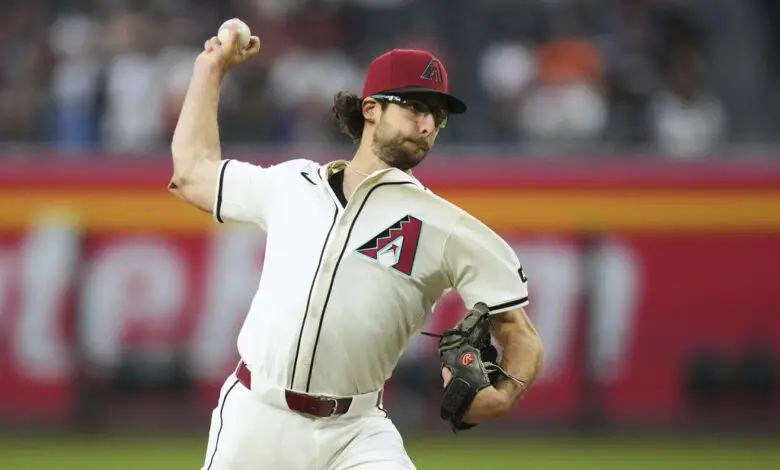
Reports in December connected the Cubs to Zac Gallen, but they ended up trading for Cabrera instead. Despite seemingly having enough starting pitchers, although in fairness you can never truly have enough starting pitching, the team was connected to Gallen once again at Cubs Convention. As if he knew I was working on this piece, Levine continued to focus on Zac Gallen during a segment on 104.3 The Score on Tuesday.
.@MLBBruceLevine believes the Cubs are in a solid position in the Zac Gallen sweepstakes. pic.twitter.com/0P1qJDhDwk
— 104.3 The Score (@thescorechicago) February 3, 2026
A larger name in terms of contract demand is Framber Valdez, the best free agent still available. Valdez crossed up his catcher near the end of last season, which could possibly be affecting his market. Nonetheless, the fact that he has not found a home with less than two weeks until workouts begin is surprising. Unless his price drops more than the current demand suggests, the Cubs likely will not be in the mix.
The real question is whether the Cubs truly need to add to their pitching depth. Assuming no injuries occur during spring training, the Cubs rotation appears set. Cade Horton, Matthew Boyd, Edward Cabrera, Jameson Taillon, and Shōta Imanaga are expected to be the five pitchers to start games at the beginning of the year. Once Steele returns, things get complicated. Craig Counsell could go to a six-man rotation, but there is still plenty of time before Steele rejoins the fray. One of the original five pitchers could get injured or fail to perform to expectations.
Adding another arm, such as Gallen, would create an even more complicated logjam. However, as mentioned earlier, having too many pitchers is a good problem to have. It is a difficult situation to navigate and would likely require Gallen’s price to fall to a level the Cubs could not refuse.
After posting a 4.83 ERA across 192 innings, Gallen will not be getting the payday he may believe he deserves. Posting the worst season of your career right before hitting free agency is less than ideal, which may push Gallen toward a short-term deal that allows him to rebuild his value before returning to the open market. If that happens, the upside of such a contract probably would not be enough to make it worthwhile for the Cubs.
I mentioned Chris Bassitt in early January, and I want to revisit that idea. Bassitt is still a free agent and may be my favorite option if the Cubs want to add another starting pitcher. With the injury risks previously mentioned, the main thing the Cubs need is consistency. Bassitt is the definition of consistency, having posted more than 2.0 fWAR in each of the last five seasons. In 2025, he had a 3.96 ERA and a 7.1 percent walk rate. He produced ground balls at a 46.1 percent rate, with an average exit velocity of 87.7 mph.
He does not throw hard, averaging just 91.6 mph on his sinker and 91.5 mph on his four-seam fastball. That would fit with the Cubs current staff, which rarely features high-velocity pitchers.
The most intriguing part about Bassitt is his ability to pitch both in the rotation and in the bullpen. Bassitt started 31 games during the regular season, logging 170.1 innings. Once the playoffs arrived, John Schneider moved Bassitt into a relief role, where he flourished. He threw 8.2 innings during the Blue Jays run to the World Series, recording 10 strikeouts and allowing just one earned run.
The Cubs already having a nearly full rotation is the main roadblock to adding another arm. Bassitt’s flexibility would allow Counsell to shift him into the bullpen if the rotation becomes too crowded at any point.
Another affordable option, one that would not carry as much financial risk as Gallen, is Lucas Giolito if the Cubs are inclined to add another arm. The 31-year-old is coming off an interesting season in which he posted a 3.41 ERA with an expected ERA of 5.06. He gave up a significant amount of hard contact while dealing with a hamstring strain at the beginning of the year. Right before the season ended, he suffered an elbow injury that caused him to miss the American League Wild Card Series.
Unlike Gallen’s situation, signing Giolito to a one-year deal is probably the wiser route. He will likely want a prove-it deal to secure a larger contract at a later date, and past seasons show the upside that is still possible. He could provide more depth for the rotation without requiring top dollar for a veteran name.
With pitchers and catchers set to report in just over a week, names such as Valdez and Gallen should be signing rather soon. There are still several options available, and the Cubs seemingly remain in the mix for a number of them.